The Mirrors Scriptures Hold Before Us
The journey begins in Vrindavan, where Krishna is no longer physically present, yet everything seems filled with Him.
The rivers still flow past the places where He once played. The trees, hills and pathways carry memories of His footsteps. For the gopis, even the wind awakens remembrance.
Their eyes do not see Krishna, but their hearts find Him everywhere.
Their separation is painful, yet it does not turn into bitterness. Longing becomes remembrance, and remembrance becomes devotion.
Sometimes distance is not the end of love. It is where love is purified.
Love Beyond Possession
The gopis represent that pure space within us where love rises beyond possession.
In today’s relationships, love is often tied to presence, attention and reassurance. We feel secure when someone responds as expected and remains close in the way we desire.
When distance enters, we begin to question the love itself.
But the gopis show us another way.
True love does not merely ask, “Why are you not here?”
It quietly asks, “What has your presence awakened within me?”
Not every absence is emptiness. Sometimes separation reveals the depth and purity of what we carry in our hearts.
When Grace Arrives at Our Door
The story then moves to Mathura, where Krishna visits Trivakra.
Long ago, she had offered Him sandalwood paste with sincerity. That simple act had touched His heart, and now grace arrived at her door.
Yet when the infinite stood before her, her desire remained centred on immediate personal happiness.
Trivakra is not a character to be judged. She represents a tender and very human stage of spiritual growth.
Grace had entered her life, but her desires had not yet expanded to match the greatness of the blessing she had received.
How often does the same happen to us?
Life gives us meaningful relationships, wisdom, opportunities, prosperity and spiritual guidance. Yet we may use these blessings only to seek comfort, recognition, success or relief from difficulty.
We stand before something sacred, but ask only for what is temporary.
Grace meets us where we are, but gently invites us to rise.
What Within Me Must Become Free?
From Trivakra’s home, the story moves to Akrura.
When Krishna enters his home, Akrura welcomes Him with deep reverence. But instead of asking only for worldly fulfilment, he prays for freedom from the attachments that silently bind the heart.
He understands that the greatest blessing is not always receiving more.
Sometimes it is being released from what keeps us inwardly restless.
Our chains today may not be visible. They may appear as ambition, approval, comparison, control, status or the constant need to prove ourselves.
At times, they even hide behind noble words such as love, duty and responsibility.
Akrura represents the moment when the heart begins to ask a deeper question:
Not only, “What more can life give me?”
But,
“What within me must become free?”
When Attachment Silences Conscience
Krishna then sends Akrura to Hastinapura, and the story enters a more difficult world.
There, Akrura sees the Pandavas living under the shadow of jealousy and injustice.
He listens, observes and understands before he speaks. Then, with respect but also courage, he advises Dhritarashtra to treat the Pandavas and his own sons equally.
Dhritarashtra hears the truth. He recognises its wisdom.
Yet he admits that his attachment to his sons is stronger than his ability to act upon it.
This is the mirror that scriptures hold before us.
Most of us do not struggle because we never know what is right.
Often, we know.
We know when we are being unfair. We know when ego, fear or insecurity is guiding our decisions. We know when someone close to us needs correction.
Yet knowing and becoming are not the same.
Dhritarashtra represents the blindness created when attachment becomes stronger than conscience.
His physical blindness becomes symbolic of a deeper inner blindness: the unwillingness to see clearly when truth threatens what we are emotionally attached to.
This blindness still appears today.
It appears when parents defend the wrongdoing of their children.
It appears when leaders value loyalty more than fairness.
It appears when we tolerate harmful behaviour in the name of love.
It appears whenever silence feels easier than truth.
True love does not protect someone from truth.
It protects them from moving further away from what is right.
When Pain Becomes Prayer
Amid this tension stands Kunti.
Surrounded by hostility and uncertainty, she speaks with tears in her eyes. She does not hide her fear or pretend to be strong.
She remembers Krishna, calls out to Him and places her helplessness at His feet.
Kunti represents the heart that allows suffering to become surrender.
Her prayer reminds us that spirituality does not mean we never feel afraid, lonely or broken.
It means that in those moments, we still know where to turn.
Prayer may not remove the storm immediately.
Sometimes it gives us an anchor while the storm continues.
It may not change the outer situation at once, but it changes the way we stand within it.
A Journey Through the Human Heart
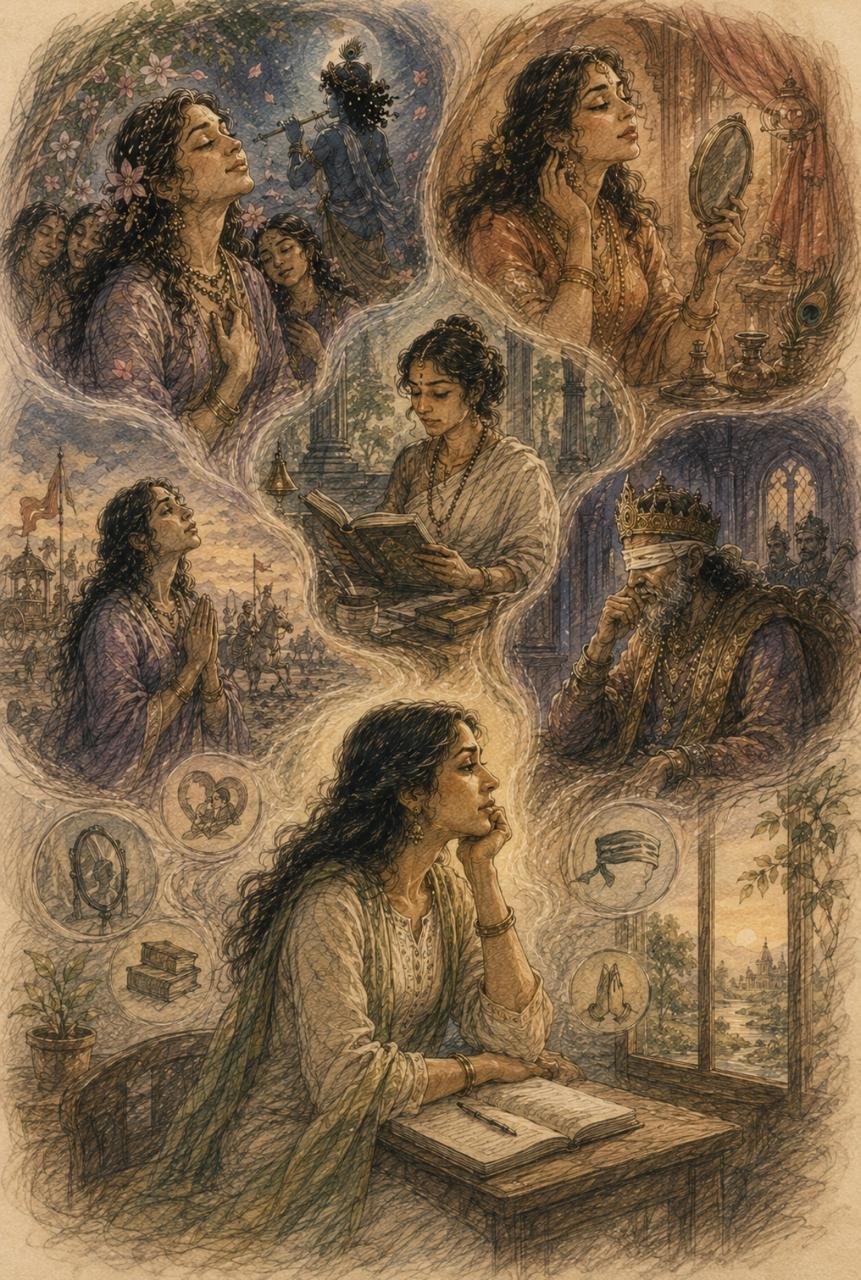
The journey from Vrindavan to Mathura and Hastinapura becomes a journey through the human heart.
The gopis appear within us when love becomes remembrance.
Trivakra appears when grace touches us, but our desires remain centred on ourselves.
Akrura awakens when wisdom begins to free us from attachment and guide us toward right action.
Dhritarashtra takes over when affection silences conscience.
Kunti emerges when pain becomes prayer and helplessness becomes surrender.
These characters are not distant figures from another age.
They are inner states through which we move every day.
The spiritual journey is the distance between knowing and becoming.
It begins when love becomes purer than possession, desire becomes deeper than gratification, wisdom becomes courageous, conscience becomes stronger than attachment, and suffering becomes a doorway to surrender.
Then separation becomes remembrance, grace becomes transformation, and every difficult choice becomes an opportunity to move closer to the Divine.