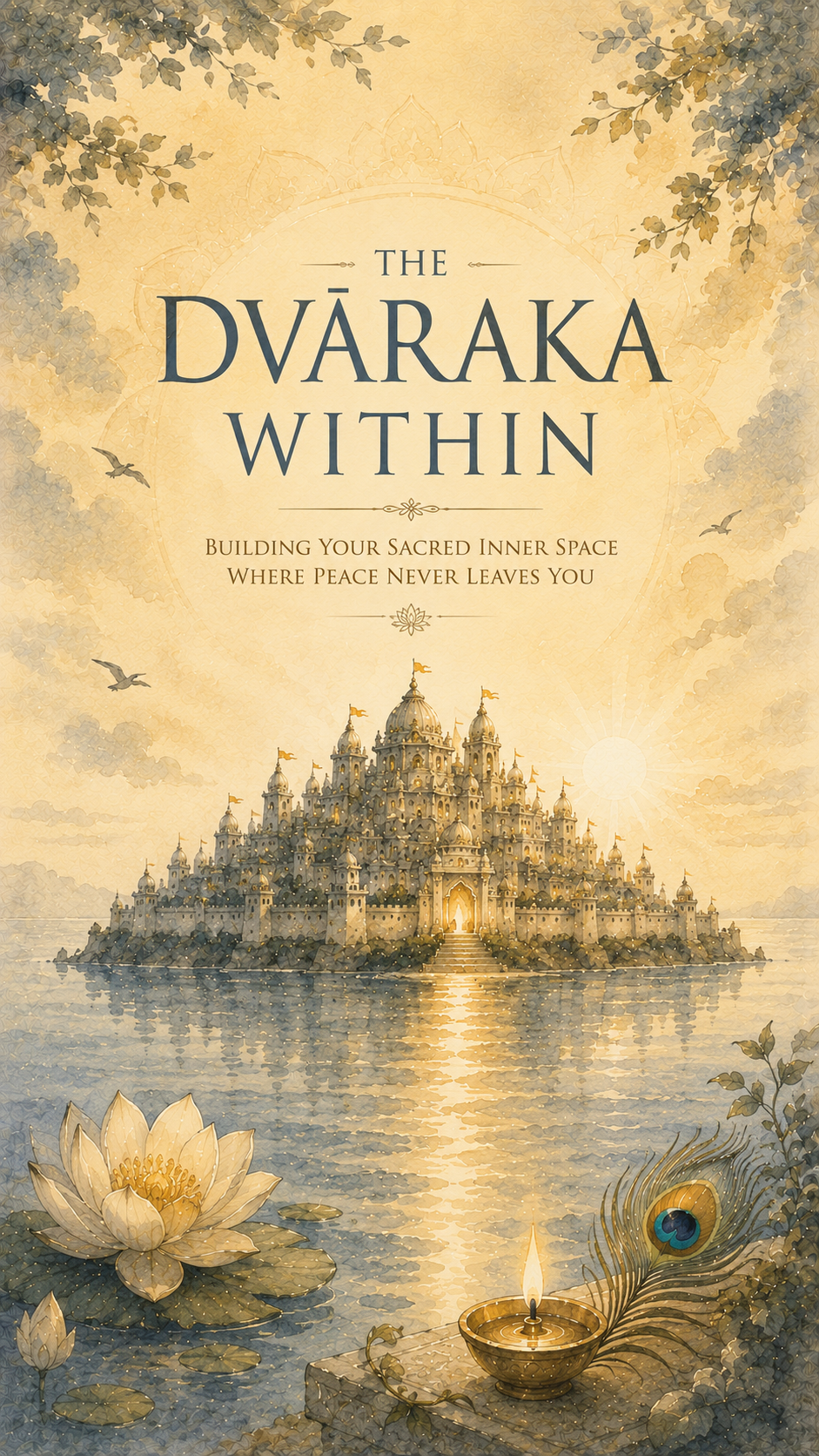
The Dwaraka Within
Mathura was surrounded.
Beyond its walls stood an army so vast that it appeared like an ocean rising beyond its shores.
Chariots, elephants, horses and soldiers stretched across the land.
At their centre stood Jarasandha, a powerful king whose grief had hardened into anger.
His daughters had returned home as widows after the death of Kamsa. Their sorrow became his sorrow.
But instead of allowing pain to soften his heart, Jarasandha allowed it to become vengeance.
He no longer wanted justice.
He wanted the entire Yadu dynasty destroyed.
And perhaps this is how many battles begin.
Not only on fields of war…
but also within homes, workplaces and human hearts.
When Pain Becomes Anger
Pain that is not understood often becomes blame.
Blame becomes anger.
And anger begins searching for someone to punish.
An old wound enters a new relationship.
One disappointment becomes distrust of everyone.
One person’s action becomes a reason to condemn an entire family, group or community.
Perhaps, before reacting, we need to ask ourselves:
Am I responding to what is happening now…
or am I reacting through a wound from the past?
The Strength to Pause
As the people of Mathura looked upon the approaching army, fear spread through the city.
Yet Krishna did not react in haste.
Although He possessed the power to destroy the enemy instantly, He paused.
He considered the time, the place and the deeper purpose of His action.
That pause is one of the most beautiful moments in the story.
We often imagine strength as immediate action.
We believe that a powerful person must answer quickly, strike back strongly and never appear uncertain.
Yet Krishna shows us another kind of strength.
The strength to pause before acting.
Modern life rarely encourages such a pause.
We reply to messages while angry.
We make decisions while anxious.
We defend ourselves before understanding what has truly happened.
But wisdom is not simply knowing what we can do.
Wisdom is knowing:
What should be done?
When should it be done?
And why?
When a Problem Returns
Krishna entered the battlefield with Balarama and defeated Jarasandha’s immense army.
Yet when Jarasandha himself was captured, Krishna asked Balarama to release him.
It appeared as though the problem had been allowed to escape.
But Krishna saw what others could not see.
He knew that Jarasandha would return, gathering more destructive forces around him.
Those forces, scattered across the land, would come together and eventually be removed.
Sometimes life also allows a difficulty to return because it is revealing something deeper.
We may meet the same conflict in different relationships.
We may repeatedly feel ignored, burdened or betrayed.
We may leave one situation, only to discover the same emotional pattern waiting for us somewhere else.
The faces change.
But the experience remains.
The Jarasandha Within Us
Jarasandha returned to Mathura again and again.
Each time, his army was defeated.
Yet each time, he gathered another one.
His repeated attacks resemble the samskaras within us — the deeply rooted tendencies that return even after we believe we have overcome them.
Anger returns.
Fear returns.
The need for approval returns.
Attachment, comparison and overthinking gather their armies once again.
But their return does not always mean that our inner work has failed.
It may simply mean that the roots go deeper than we realised.
Each time we meet the same tendency with greater awareness, it loses a little of its power.
When Life Changes the Battlefield
Then the situation changed.
While Jarasandha prepared to attack once more, another warrior named Kalayavana arrived with an enormous army and surrounded Mathura from the other side.
Now the danger was no longer coming from one direction.
Krishna understood that if He and Balarama remained occupied in battle, the families and citizens of Mathura could be harmed or taken away.
And at this moment, Krishna did something deeply significant.
He did not continue using the same strategy simply because it had worked before.
He did not remain in Mathura merely to prove that He was fearless.
He chose to protect His people first.
Within the sea, He created the magnificent and secure city of Dwaraka.
Its roads were broad.
Its gardens were beautiful.
Its homes were filled with abundance.
It had places of worship, marketplaces, treasuries, watchtowers and spaces for every part of community life.
Then, through His divine power, Krishna moved the people of Mathura into this protected city.
The Heart of Spiritual Leadership
This is the heart of spiritual leadership.
A true leader does not ask only:
“How can I win?”
A true leader also asks:
“What will happen to those who depend on me while I am trying to win?”
Parents, teachers, founders, managers and community leaders can all learn from Krishna’s decision.
Before taking a great risk, protect what is vulnerable.
Before pursuing ambition, safeguard:
Your health.
Your relationships.
Your values.
Your peace of mind.
Courage without responsibility can become recklessness.
Leaving Is Not Always Running Away
Krishna’s movement from Mathura to Dwaraka carries another gentle lesson.
Leaving is not always running away.
Sometimes we stay in harmful situations because we fear what others may think.
We continue arguments that have lost all meaning.
We remain in unhealthy relationships or failing strategies because our ego cannot accept withdrawal.
But Krishna did not allow pride to decide His path.
He changed His position without changing His purpose.
The deeper question is therefore not simply whether we stayed or left.
The deeper question is:
Did we act from fear…
or did we act from clarity?
Building Dwaraka Within
Dwaraka, built within the sea, becomes a beautiful symbol of the inner life.
The sea is always moving.
Waves rise and fall.
Storms arrive without warning.
In the same way, life constantly brings change.
Praise and criticism.
Success and disappointment.
Closeness and separation.
We cannot still every wave.
But we can build a city within.
Its strong walls are our values.
Its watchtowers are awareness.
Its pathways are clarity.
Its temples are the moments in which we remember the Divine.
Its protected gates are the boundaries through which we decide what may enter our mind and heart.
An inner fortress is not a heart closed to love.
It is a heart protected from what repeatedly destroys its peace.
The Invisible Weapons We Carry
After settling His people safely in Dwaraka, Krishna returned to Mathura.
He walked out through the main gate wearing a garland of lotuses…
but carrying no weapons.
It is a striking image.
The same Krishna who could destroy enormous armies now stepped forward unarmed.
His power did not come from the weapons He carried.
It came from the completeness within Him.
We too carry invisible weapons.
Defensiveness.
Sarcasm.
Control.
Status.
Silence used as punishment.
The constant need to prove ourselves.
Sometimes spiritual maturity means entering a conversation without these weapons.
It means listening without preparing a counterattack.
It means seeking truth rather than victory.
When the Storm No Longer Rules You
The story of Dwaraka reminds us that we do not have to spend our entire lives fighting every Jarasandha who appears.
We can recognise the recurring pattern.
We can change our strategy when life changes.
We can protect what is vulnerable without feeling weak.
We can step away without believing that we have lost.
And most importantly…
we can build within ourselves a place so deeply anchored in wisdom that the storms outside no longer decide the state of our heart.
The sacred city of Dwaraka continues to be a place of devotion and remembrance.
And perhaps its story also invites us to carry its wisdom within.
To build an inner Dwaraka.
A sacred space where our values become the walls…
awareness becomes the watchtower…
clarity becomes the path…
and remembrance of the Divine becomes the temple within.
Because the greatest victory is not always the destruction of an enemy.
Sometimes the greatest victory is the creation of a city within.
A quiet and sacred space where fear cannot rule,
pride cannot command,
and the Divine is never forgotten.