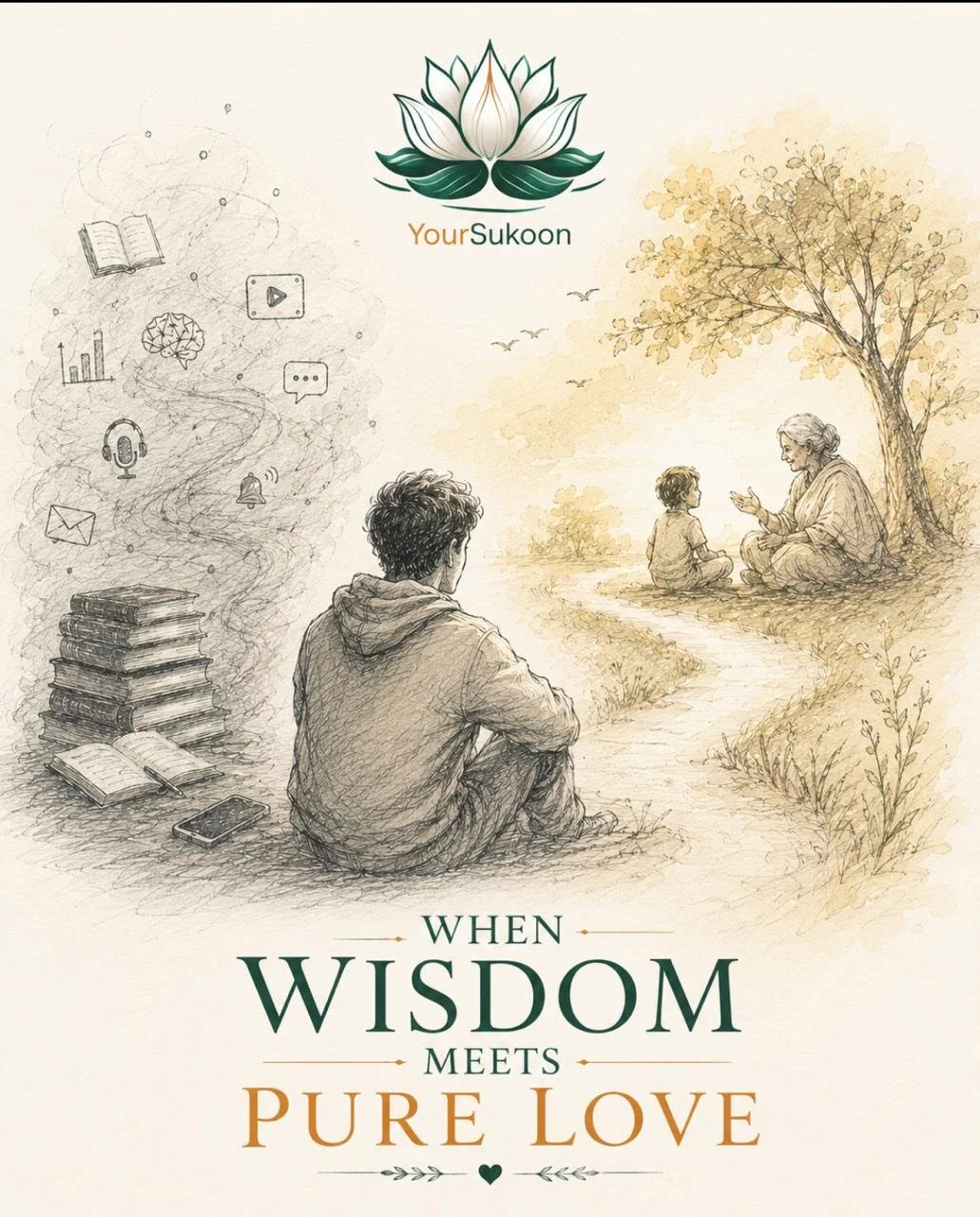
When Wisdom Approaches Love
A Sacred Story for Today’s Life
Krishna is in Mathura.
Vrindavana is in remembrance.
Nanda, Yashoda, and the Gopis are not merely missing Krishna. Their entire inner world has become filled with Him. The lanes of Vrindavana remember His footsteps. The forests remember His laughter. The cows, the river, the evening dust, the sound of daily work, everything carries His presence.
To comfort them, Krishna sends Uddhava.
But Uddhava is not only a messenger in this story. He represents higher consciousness, mature wisdom and the awakened mind.
And yet, Uddhava is not dry wisdom.
He is wisdom touched by devotion.
He is intelligence softened by love.
He is maturity that does not stand at a distance, but travels toward suffering with empathy and grace.
When Wisdom Meets Pure Love
Uddhava is wise, composed and deeply connected to Krishna. He understands the larger reality. He knows that Krishna is not limited to one place, one form, one family or one relationship.
But Vrindavana carries another kind of knowing.
Uddhava knows Krishna through wisdom.
Vrindavana knows Krishna through love.
And this is where the story becomes a manual for today’s living.
Information is not transformation.
We live in an age where the mind is constantly fed. We read, listen, watch, learn, compare, analyse and plan. We know the language of success, healing, mindfulness, purpose and personal growth.
Yet many hearts feel tired.
The mind has become full, but the heart has not always become peaceful.
Knowing about peace is not the same as becoming peaceful.
Knowing about love is not the same as loving with purity.
Knowing about the Divine is not the same as remembering the Divine while living an ordinary day.
Creating Vrindavana in Daily Life
Vrindavana teaches us that spirituality is not a separate compartment of life. It is not limited to a prayer room, a ritual, a scripture or a particular hour of the day.
Spirituality is the fragrance that enters life when the center of the heart becomes sacred.
The people of Vrindavana are not escaping life. They are working, caring, cooking, waiting, remembering and continuing. Their life is outwardly simple, but inwardly luminous.
Krishna has become the center of their being.
And because the center is sacred, the whole circle of life becomes sacred.
This is a powerful lesson for modern life.
We do not have to wait to visit Vrindavana. We can begin creating Vrindavana in our own home, in our own relationships, in our own way of living.
Whenever a home becomes filled with remembrance, patience, softness and care, a small Vrindavana begins there.
Whenever daily work becomes sincere, food becomes gratitude, speech becomes gentle, and relationships become spaces of respect, life begins to carry the fragrance of Vrindavana.
Begin With What Is Already in Your Hands
Do not wait for life to become perfect before becoming spiritual.
Begin with what is already in your hands.
Light a lamp with awareness.
Speak to your family with softness.
Do your work with sincerity.
Eat with gratitude.
Listen without preparing your reply.
Pause before reacting.
Remember the Divine before beginning the day.
Let your routine become a quiet offering.
Peace does not always arrive when the outer situation changes. Many times, peace begins when the inner center changes.
The Inner Uddhava Within Us
Every person needs an inner Uddhava.
A higher consciousness within us that can guide our emotions without suppressing them. A mature wisdom that can help us love without losing ourselves. A calm awareness that reminds us to respond instead of react, to listen instead of assume, and to surrender instead of control.
But every person is also called to become Uddhava for someone else.
When someone is in suffering, we may not always be able to solve their situation. We may not have the power to remove their pain immediately.
But we can carry encouragement.
We can carry empathy.
We can carry patience.
We can carry a message of hope.
To be Uddhava in someone’s life is to arrive without judgment.
To listen without hurry.
To remind them that they are not forgotten.
To bring warmth where there is loneliness.
To bring faith where there is confusion.
To bring Krishna’s message in the form of compassion, presence and hope.
Sometimes, this is the greatest service we can offer.
Not advice that feels heavy.
Not philosophy that dismisses pain.
But wisdom combined with devotion.
A presence that says, “I am with you. This pain is real, but it is not the end of your story.”
Wisdom Should Become Gentle
The story also reminds us that higher consciousness should not become dry or distant.
Wisdom is precious. It gives direction. It protects us from confusion. It helps us see beyond temporary emotions. It gives us the strength to pause, reflect and choose well.
But wisdom must remain gentle.
When knowledge becomes proud, it becomes dry.
When knowledge becomes humble, it becomes light.
Love is equally precious. Love gives warmth, meaning and beauty to life.
But love too needs refinement.
When love becomes ownership, it creates fear.
When love becomes expectation, it creates restlessness.
When love becomes surrender, it becomes prayer.
This is the balance today’s world deeply needs.
Wisdom should make love mature.
Love should make wisdom tender.
A person who has only knowledge may understand life, but may not touch hearts.
A person who has only emotion may feel deeply, but may lose balance.
But when wisdom and love come together, life becomes graceful.
Why Krishna Sends Uddhava to Vrindavana
This is why Krishna sends Uddhava to Vrindavana.
Not only to deliver a message.
Not only to console those who are in longing.
But to create a sacred meeting between two great paths.
The mind must meet the heart.
Clarity must meet tenderness.
Understanding must meet surrender.
Higher consciousness must bow before pure love.
A Lesson for Relationships
This is also the secret of healthy relationships.
In homes, marriages, friendships and communities, we often struggle because we want to be understood before we try to understand.
We want our pain to be seen.
We want our effort to be valued.
We want our intention to be recognised.
Slowly, love becomes surrounded by demand, and communication becomes surrounded by defence.
Vrindavana invites us into a softer and deeper way of living.
Can I love without controlling?
Can I care without possessing?
Can I remember without demanding?
Can I speak truth without wounding?
Can I be wise without becoming hard?
Can I be emotional without losing balance?
These are not small questions.
They are the real spiritual practice of daily life.
Transforming Longing Into Prayer
The story also gives us a profound way to understand absence.
Sometimes someone we love is physically away. Sometimes a phase of life ends. Sometimes a dream changes shape. Sometimes a prayer seems unanswered. Sometimes the Divine feels silent.
In such moments, the heart naturally feels pain.
Spirituality does not ask us to deny that pain.
Vrindavana does not deny longing.
It transforms longing.
There is pain that closes the heart, and there is pain that deepens the heart.
When pain is mixed with ego, it becomes complaint.
When pain is held with awareness, it becomes maturity.
When pain is offered with love, it becomes prayer.
We cannot control every separation, every delay, every uncertainty or every unanswered prayer.
But we can choose what our heart becomes through it.
Does difficulty make us bitter or deeper?
Does waiting make us restless or more prayerful?
Does love make us dependent or more expansive?
Does knowledge make us superior or more compassionate?
Vrindavana shows that the Divine is not absent simply because life feels difficult. Sometimes the Divine is hidden inside the very longing that is refining us.
The Spirit of YourSukoon
Uddhava arrives as a messenger of Krishna, but Vrindavana itself becomes the message.
He comes with understanding, but he witnesses devotion.
He comes with wisdom, but he discovers love.
He comes to console, but he is inwardly transformed.
That is the quiet beauty of this episode.
The highest spiritual state is not dry detachment. It is not emotional escape either.
It is love purified by wisdom and wisdom softened by love.
This is deeply aligned with the spirit of YourSukoon.
Ancient wisdom is not meant to take us away from modern living. It is meant to bring more depth, softness, awareness and sacredness into modern living.
It is meant to help us live with a calmer mind, a cleaner heart and a deeper sense of connection.
To live like Vrindavana does not mean leaving the world.
It means carrying remembrance into the world.
It means doing our duties without losing our center.
It means loving people deeply without turning love into control.
It means accepting change without becoming empty inside.
It means allowing wisdom to guide our emotions and allowing love to refine our actions.
Let Your Daily Life Become an Offering
Krishna sending Uddhava to Vrindavana is not only a sacred story.
It is a guide for every seeker who is trying to live with meaning in the middle of ordinary responsibilities.
Let your wisdom become humble.
Let your love become pure.
Let your work become worship.
Let your pain become prayer.
Let your relationships become spaces of care, not control.
Let your home become a living Vrindavana.
Let your daily life become a place where the Divine can be remembered.
Because true sukoon is not a life without responsibilities, longing or change.
True sukoon is a heart that has found its center.
A heart where wisdom bows to love.
A heart where love is guided by wisdom.
A heart where higher consciousness becomes tender, and tenderness becomes sacred.
And perhaps that is the final message of Vrindavana.
The Divine is not far from us.
We lose Him only when we live without remembrance.
We find Him again when wisdom becomes gentle, love becomes selfless, and life itself becomes an offering.