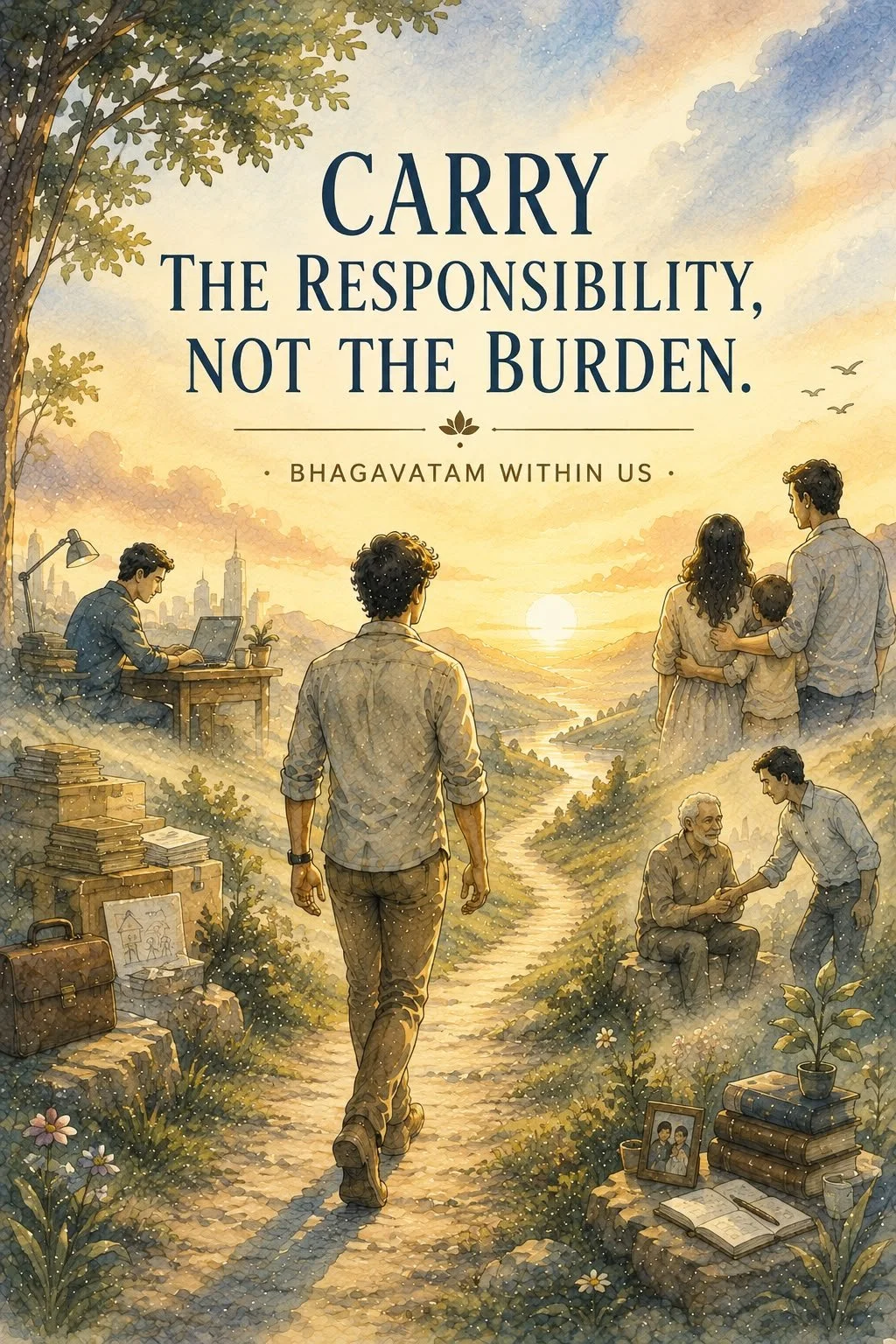
The Bhagavatam Within Us
There is a kind of tiredness that sleep does not cure.
Life may actually be going well. The career is moving forward. The family is being taken care of. Responsibilities are being fulfilled. People around us may even admire how much we are able to manage.
And yet, somewhere beneath all that competence, there is exhaustion.
Not simply the tiredness of the body, but the tiredness of always having to think, decide, respond, provide, protect and remain available.
In the Srimad Bhagvatam, we meet King Mucukunda, a powerful ruler who had been awake for far too long.
When the celestial beings were struggling against powerful enemies, they sought his help. Mucukunda answered their call and spent a long period protecting them. He fought, served and remained vigilant until, eventually, his duty was complete.
But when he was finally released from that responsibility, he discovered something perhaps no warrior is ever prepared for.
While he had been busy protecting one world, his own world had moved on.
The people of his time, his family, companions, ministers and those who had once filled his everyday life were no longer there. Time had quietly carried them away.
Mucukunda had not failed.
In fact, he had fulfilled his duty with extraordinary commitment.
And yet, life had passed while he was busy fulfilling it.
How familiar that feels.
We tell ourselves:
Once this project ends, I will slow down.
Once the business becomes stable, I will have more time.
Once the children settle, I will think about myself.
Once I reach the next milestone, I will finally breathe.
But one milestone quietly becomes another. The inbox refills. The next target appears. Someone else needs us.
And life does not announce that another year has disappeared.
When Mucukunda was offered a boon for his long service, he could have asked for wealth, power or another kingdom.
Instead, he asked for something extraordinarily simple.
He wanted to sleep.
Perhaps there could be no more honest request from someone who had been responsible for too long.
There are many Mucukundas around us today.
The entrepreneur whose mind remains inside the company even while sitting with family. The parent carrying everyone else's worries. The professional whose identity has slowly become inseparable from achievement. The young adult trying to build a career, maintain relationships, stay healthy and somehow also remain peaceful.
The body may lie down at night.
But the mind remains on duty.
Mucukunda entered a secluded cave and surrendered himself to a long, deep sleep.
Much later, Krishna was being pursued by Kalayavana, an aggressive warrior determined to fight him. Krishna did something unexpected. Instead of giving Kalayavana the battle he wanted, he simply kept moving ahead.
Kalayavana followed, insulted him and assumed Krishna was running away out of weakness. Eventually Krishna entered the cave where Mucukunda was sleeping.
Kalayavana followed.
In the darkness, he mistook the sleeping Mucukunda for Krishna and angrily kicked him awake.
Mucukunda opened his eyes. His furious gaze fell upon Kalayavana, who was immediately consumed by fire.
Beneath this dramatic moment lies a very human truth.
Sometimes our reaction to the present carries the exhaustion of many moments that came before it.
Someone says something small and we explode. A minor inconvenience feels enormous. One more phone call feels unbearable.
Later we wonder:
Why did I react so strongly?
Perhaps the incident was small.
But the tiredness behind it was not.
We often think burnout happens when life is going badly. Mucukunda's story suggests something different.
Sometimes exhaustion comes from being capable for too long.
The person who always manages is given more to manage. The person who rarely says no is given more to carry. The person who appears strong is rarely asked whether they are tired.
Success itself can quietly become heavy.
Every promotion brings another responsibility. Every achievement creates another expectation. Every expansion introduces another problem to solve.
And slowly, one of the heaviest thoughts we can carry takes root:
Everything depends upon me.
When Krishna finally appeared before Mucukunda, something deeper began to awaken within the king.
Mucukunda looked back at the life he had once considered so important: his kingdom, wealth, position, family, power and recognition.
He realised how completely he had confused these things with who he truly was.
And here the story moves beyond exhaustion into something deeper: identity.
We too collect identities.
Founder. Professional. Parent. Leader. Provider. Achiever.
There is nothing wrong with these roles. Life asks us to play many roles.
But there is a difference between having a role and becoming the role.
When work becomes our identity, a setback feels like personal failure.
When success becomes our identity, someone else's progress feels threatening.
When being needed becomes our identity, saying no feels selfish.
And when responsibility becomes our identity, even rest can make us feel guilty.
Mucukunda begins to understand what years of activity had hidden from him:
What we do is important. But it is not all that we are.
Krishna then offered him a boon.
The king who once possessed great power no longer asked for more power. The man who had known kingdoms did not ask for another kingdom.
He asked for something deeper: a mind anchored in the Divine and freedom from the endless hunger for more.
Something within him had changed.
The question was no longer:
What else can I achieve?
It had become:
What is truly worth wanting?
Perhaps maturity is not the end of ambition.
It is learning what ambition is worth sacrificing for, and what it is not.
There is another quiet wisdom in the way Krishna dealt with Kalayavana.
Kalayavana wanted a fight.
Krishna did not give him one.
To Kalayavana, walking away looked like weakness. But Krishna simply refused to fight an unnecessary battle on someone else's terms.
Our lives offer us similar battles every day.
A criticism. A misunderstanding. An unpleasant message. Someone questioning us. Someone disagreeing with us.
The ego says:
Answer. Defend yourself. Prove your point. Win.
Wisdom sometimes says:
Let it go.
Not every battle deserves our energy.
Not every criticism needs our response.
Not every misunderstanding needs to be corrected.
Sometimes peace does not come from winning the battle.
It comes from realising that we never needed to enter it.
Perhaps there is a part of each of us that has been awake for too long.
Always planning. Always worrying. Always solving. Always carrying. Always trying to keep everything together.
Maybe we do not simply need more sleep.
Maybe we need to ask:
What am I carrying that I can finally put down?
The need to control everything?
The need to please everyone?
The need to prove ourselves?
The belief that everything depends upon us?
Real rest may begin there.
Not by escaping responsibility, but by changing our relationship with it.
Work sincerely. Care deeply. Give your best. Take responsibility.
But remember, the roles you play are part of your life. They are not the whole of who you are.
Mucukunda entered the cave because he desperately needed sleep.
But when he emerged, his deeper awakening was not simply from sleep.
It was from the belief that his roles, achievements and responsibilities defined him.
And perhaps that is the wisdom his story leaves for us today:
Take responsibility for your life. But do not become a prisoner of your responsibilities.