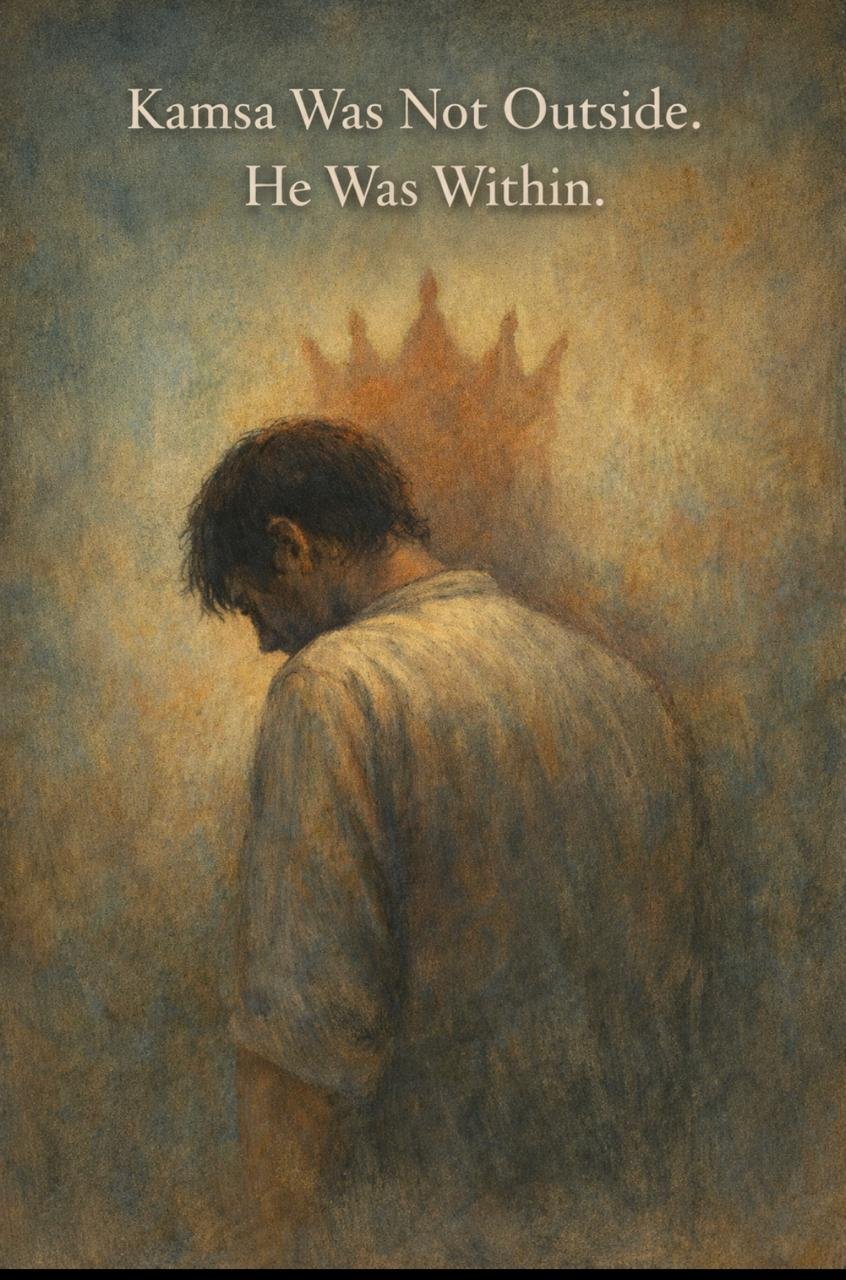
Not every tyrant lives outside us.
Some sit quietly within.
They do not wear crowns. They do not rule kingdoms. And yet they shape entire lives. They rule through fear, through control, through suspicion, through the constant feeling that something must be managed before peace can be allowed.
From the outside, everything may still appear fine. A person may look composed. A family may seem steady. A business may still be growing. Life may continue moving, and yet inwardly there is strain. Rest feels distant. Trust feels difficult. The mind remains alert even when there is no immediate danger.
This is why the episode of Krishna and Kamsa continues to speak so powerfully even today.
It is not only about the defeat of a cruel ruler. It is about the collapse of false power itself. It is about what happens when fear sits on the throne for too long, and truth finally enters the arena.
That is what makes this episode timeless.
Kamsa is not merely a figure from the past. He is also symbolic of an inner state. He is fear-hardened into force. He is insecure, which becomes domination. He is the mind that cannot rest because it is always threatened by what it cannot control.
In that sense, this is not only a sacred story. It is also a profound map of human psychology.
The inner Kamsa appears whenever fear begins to lead us more than wisdom does. It appears when control becomes stronger than trust. When anxiety turns into anger. When woundedness hides behind harshness. When the ego would rather dominate than surrender. When life stops being lived openly and starts being managed defensively.
This is why the story feels so alive in modern life.
How many people today are not actually fighting outer enemies, but inner unrest?
The fear of failure makes them overwork.
The fear of rejection makes them guarded.
The fear of uncertainty makes them controlling.
The fear of being diminished makes them reactive, proud, or constantly defensive.
What begins as fear slowly becomes personality.
And one of the deepest truths in this episode is that Kamsa was inwardly defeated long before he was outwardly overthrown. He was consumed by Krishna in thought. Even while eating, sleeping, moving, or sitting, he remained haunted by the very presence he feared.
What a striking truth that is.
What we resist most often begins to occupy us most.
A feared outcome starts shaping our choices.
An old hurt starts dictating how we relate.
A loss of trust starts influencing every decision.
A desire for control begins to disguise itself as strength.
Outwardly, one may still look powerful. But inwardly, peace has already been displaced.
That is why false power is never as stable as it appears. It can dominate for some time, but it cannot remain whole. Anything built on fear begins to collapse from within, even while still looking strong from the outside.
We see this everywhere.
A relationship still exists, but warmth has gone missing.
A career still shines, but the person inside it is exhausted.
A business is expanding, but clarity and alignment are thinning out.
A person appears successful, but inwardly feels constantly braced.
Then comes the moment when something breaks.
A pattern.
A false identity.
An illusion of control.
A way of living that has become too heavy to carry.
We often call such moments a crisis. But sometimes, they are a revelation. Sometimes, they are grace, uncovering what was already unstable. Sometimes, they are the necessary fall of what never deserved to rule in the first place.
There is another beautiful insight in this episode. In the arena, before the larger structure fully recognised the wrongness of what was happening, some hearts immediately felt the injustice. Sensitivity awakened first.
This is deeply important.
The heart often knows before the mind can explain.
Conscience often stirs before society admits what is wrong.
Inner intelligence often whispers long before life begins to shake outwardly.
Before burnout becomes visible, joy has already begun fading.
Before a relationship breaks, tenderness has already sensed the distance.
Before a path collapses, the soul has often been whispering that it is no longer aligned.
Yet many of us are trained to ignore that whisper. To stay efficient. To stay practical. To remain functional. To endure what should have been questioned. To call numbness maturity and suppression strength.
But spirituality asks for deeper honesty.
Not performance.
Not perfection.
Honesty.
The honesty to notice where fear is ruling.
The honesty to admit where control has replaced trust.
The honesty to see where our strength has quietly become tension.
The honesty to ask whether what governs us is wisdom, or simply woundedness wearing the mask of power.
And then comes the turning point.
Krishna moves.
Spiritually, this is the moment when truth within us refuses to remain passive any longer. A boundary is drawn. A false pattern is interrupted. A silence ends. Something deeper rises and says: this may have ruled until now, but it cannot rule forever.
This matters because grace is not always soft in the way we expect.
Sometimes grace comforts.
Sometimes grace confronts.
Sometimes grace protects by removing.
Sometimes grace breaks what comfort alone could never heal.
That too is sacred.
Because spirituality is not merely about feeling calm. It is about becoming aligned with what is true. And alignment often requires the fall of what has been falsely governing the inner world.
Yet the beauty of this episode is that it does not end in violence alone. It ends in restoration. Bondage is broken. Dignity is restored. Those imprisoned are freed. Strength does not become cruelty. Victory does not become arrogance.
This is the deeper wisdom.
Real victory is not only in what we defeat. Real victory is in what we become after the fall of falsehood.
If suffering makes us hard, healing is incomplete.
If truth makes us harsh, wisdom is incomplete.
If freedom removes compassion, something essential has been lost.
Krishna reveals another way.
Strength with tenderness.
Power without domination.
Truth without violence.
Liberation that makes the heart clearer, softer, and more alive.
And perhaps that is the real question this sacred moment leaves with us:
What is still sitting on the throne within me that no longer deserves that place?
A fear?
An old wound?
A restless ego?
A need to control everything?
A story that says peace must wait until life feels completely secure?
Because when truth rises, false power begins to tremble.
And when the inner tyrant finally falls, what returns is not only relief. It is breath. It is clarity. It is inner space. It is tenderness. It is the quiet remembering of a self that fear had overshadowed for too long.
That is the real liberation.
Not merely the defeat of darkness, but the return of freedom within.