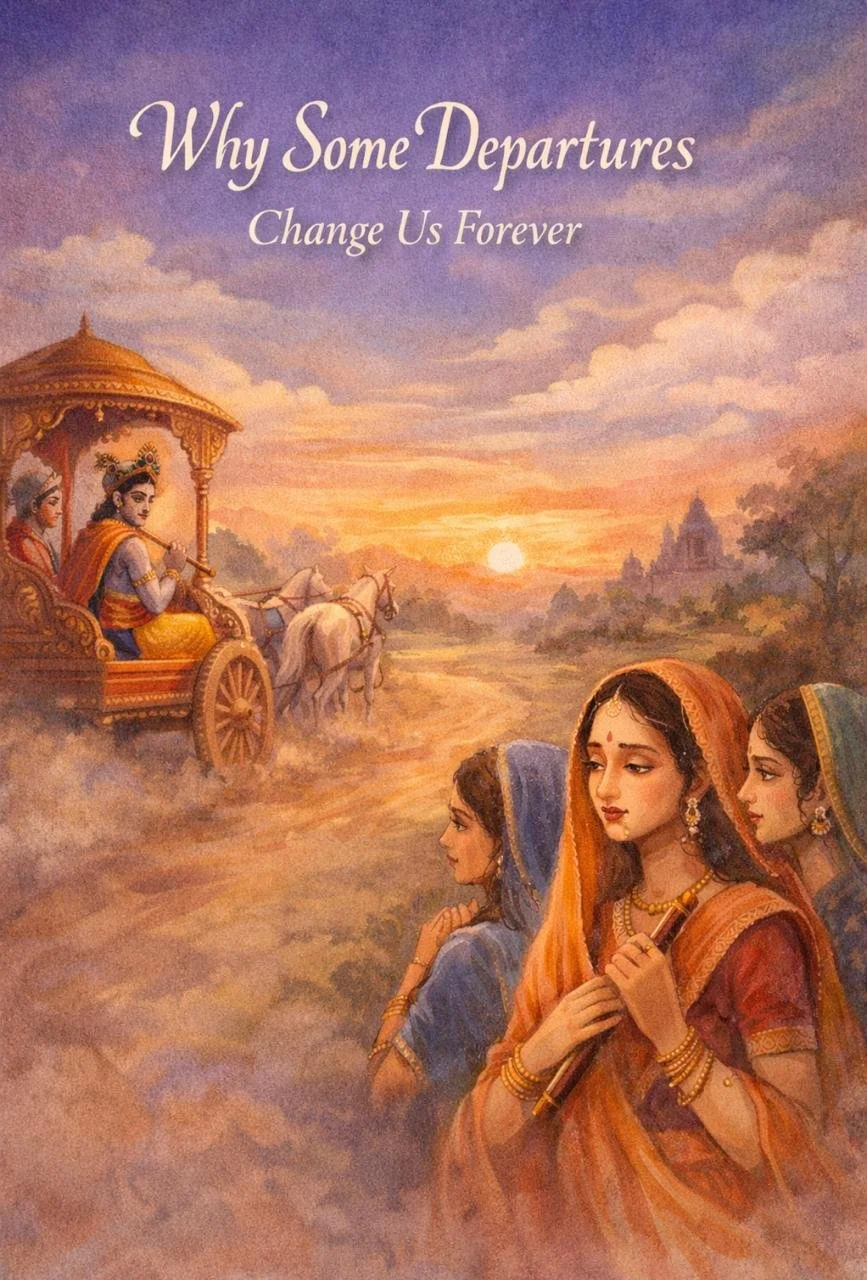
The Day Krishna Left Vrindavana: A Story That Teaches Us How to Stay Steady
That morning in Vrindavana looked normal.
The sky was the same. The lanes were the same. The Yamuna flowed as always.
And yet, one small detail carried a huge shift.
A chariot was being readied.
In the Bhagwat Mahapuran, Akrura arrives in Vrindavana with Kamsa’s message. Krishna and Balarama are called to Mathura. The Gopis hear the news, and the air changes. Then, at the Yamuna, Akrura receives a divine vision and offers prayers that feel timeless.
This episode is not meant to remain only in a sacred text. It is meant to enter our life.
Because all of us know a chariot moment, a moment when something begins to move away, and we realise we cannot hold it the way we once did.
A person.
A closeness.
A phase.
A role.
A place that felt like home.
And the mind asks: If this is leaving, what stays?
Grace Can Arrive Through an Unwanted Route
Akrura does not travel like a proud messenger. He travels with humility, almost trembling from within. He knows he is entangled in worldly life, yet his heart is pulled toward one longing: to see Krishna and Balarama.
There is something deeply comforting here.
Many people believe spiritual life belongs only to the ideal ones — those with perfect habits, perfect discipline, and perfect calm.
But Akrura shows a gentler truth.
Even an imperfect person can be drawn toward the Divine. And that pull itself is grace.
In modern life, too, grace often arrives through the very situations we resist.
A strict message.
A forced change.
An uncomfortable truth.
Even Kamsa’s harsh command becomes the doorway for Akrura to receive darshan and inner transformation.
Reflection: What situation am I calling a problem, that might also be a doorway?
Separation Reveals What Love Truly Is
When the Gopis hear that Krishna is leaving, their love does not remain polite.
There are tears, protests, anger, and helplessness. They blame fate and call Akrura cruel. The whole world feels hollow.
And somehow, it feels familiar.
Separation does not happen only in scriptures. It happens in everyday life.
A bond changes.
A friend drifts away.
A partner becomes emotionally distant.
A job ends.
A chapter closes before we are ready.
Sometimes, the loss is subtle.
You open your phone and see no reply, but your mind keeps checking anyway.
You sit in a meeting and realize your role has shifted without anyone saying it.
You come home and feel the house is the same, but the closeness is not.
Sometimes you do not lose the person.
You lose the earlier closeness.
The Gopis cannot keep Krishna beside them physically, so they keep Him alive inwardly. Through remembrance. Through song. Through the love He awakened in them.
And here lies the healing shift:
When you cannot keep the moment, keep the meaning.
Reflection:
Think of something you miss. Instead of asking, “Why did it leave?” ask, “What did it awaken in me that I must not lose?”
Two Realities Exist at Once: The Outer and the Inner
As the chariot moves away, the Gopis follow it until the flag disappears and even the dust settles. Then they stand still, like painted figures.
It is the mind’s last attempt to deny goodbye.
Then the journey pauses at the Yamuna.
Akrura steps into the water and sees something impossible. Krishna and Balarama are on the chariot, and yet he also sees them in the water.
Two realities at once.
This is not only mystical. It is deeply human.
One reality is outer: deadlines, noise, obligations, expectations, pressure.
Another reality is inner: a quiet nudge, a subtle calling, a truth you keep sensing but keep postponing.
Most people ignore the inner reality because the outer one is loud.
Akrura does not.
He goes back again.
He looks again.
He chooses depth.
Reflection: What truth do I sense quietly, but keep delaying because life is loud?
Surrender Is Not Weakness. It Is Freedom.
From that divine vision, Akrura’s heart flows into prayer.
He recognises the Supreme as the source of everything. He admits the trap of “I” and “mine.”
He admits attachment.
And then he offers one of the most healing postures of all:
Surrender.
Surrender is not passivity.
It is not giving up effort.
Surrender is when you stop fighting reality from inside.
You still do your part.
You still act with sincerity.
But you stop carrying the extra burden of resistance, bitterness, and inner argument with what already is.
A simple prayer for modern life:
Let me do my part with sincerity. And let me release what I cannot control with peace.
When Krishna Leaves Outside, He Can Be Found Within
The day Krishna left Vrindavana looked like a loss.
But the Bhagwat quietly points to a deeper possibility.
Sometimes Krishna leaves the outer Vrindavana so we can discover the inner one, a steadiness that does not depend on people, places, or perfect seasons.
So if you are in a season of change, distance, or uncertainty, hold this gently:
What left your life may not be punishing you.
It may be maturing you.
And when the mind asks,
“What stays?”
Let your heart answer:
What stays is what I have become.
A deeper love.
A quieter strength.
A presence that no departure can take away.
Gentle Closing Reflection
Not every departure is destruction.
Some departures are invitations.
An invitation to move from holding to trusting.
From outer dependence to inner anchoring.
From possession to presence.
Perhaps that is why this story still speaks across centuries.
Because somewhere, each of us has stood watching a chariot move away.
And somewhere within, each of us is still learning how to remain steady when life changes shape.