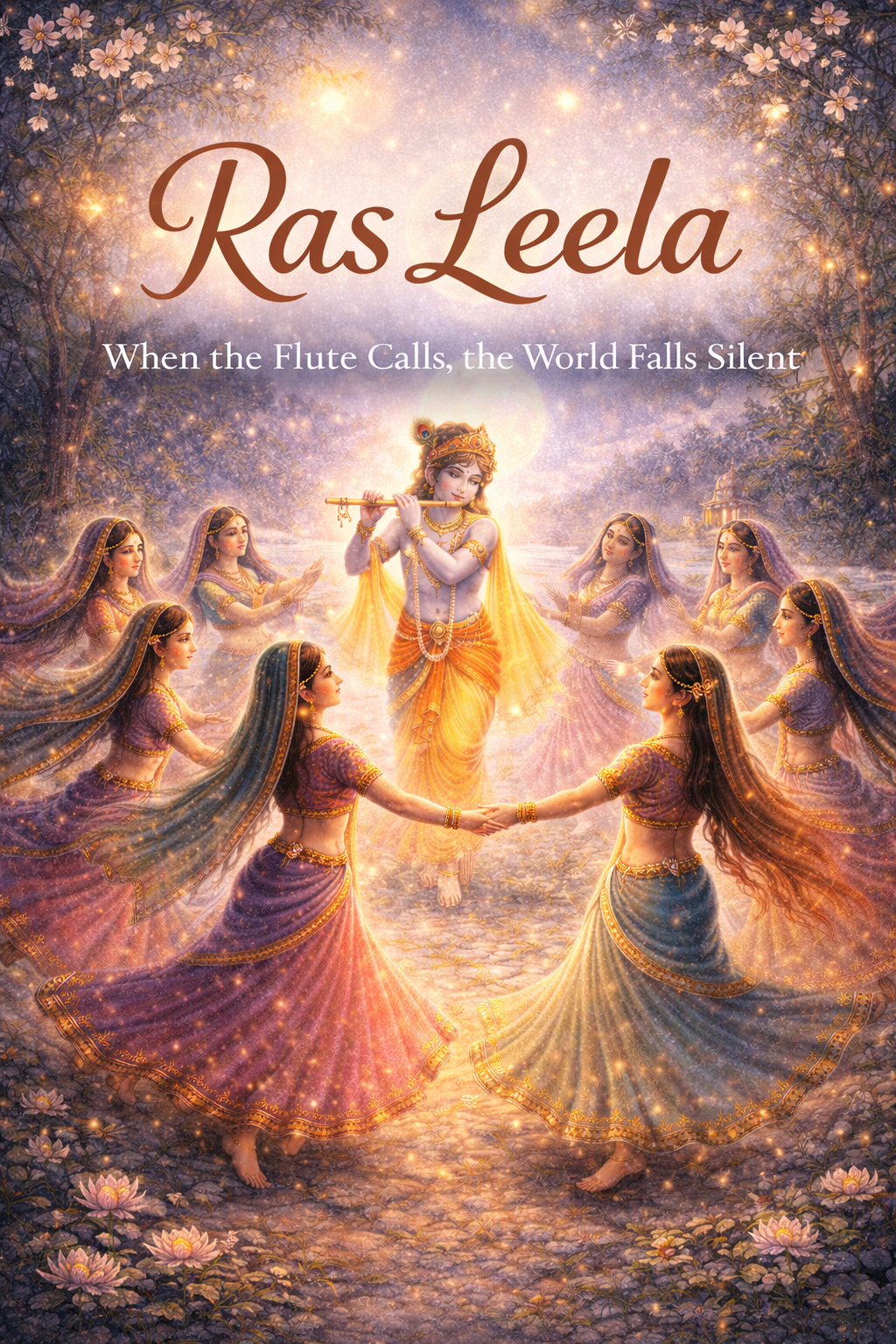
The Night Vrindavan Changed
It was an autumn night in Vrindavan.
The rains had passed.
The ponds looked clear again.
The air felt lighter, as if the world had finally exhaled.
And the moon sat full in the sky, not just as light, but as a kind of quiet awareness.
In that stillness, Krishna lifted his flute.
Not to announce anything.
Not to command.
Not to persuade.
He simply played.
And something happened that the mind cannot fully explain.
No walls fell. No homes broke.
Life did not end.
But life paused.
Milk was left half-milked.
Food was forgotten on the flame.
Hands stopped mid-task.
Thoughts dissolved mid-sentence.
Not because the Gopis were careless.
But because something truer than routine had entered the air.
This is the essence of Ras Leela.
Not merely a dance in the forest.
A turning of the soul back to its original center.
And the most surprising part is this:
Sometimes the Divine does not interrupt your life.
It simply becomes more important than everything else.
A YourSukoon refrain
When the flute calls, the noise grows quiet.
When the heart listens, the world steps aside.
And what you were chasing feels suddenly small.
Ras Leela Is Not Just a Story, It Is a Mirror
Ras Leela is often treated like an event to be described.
But the Bhagwat Mahapuran holds it as an inner truth to be recognised.
What unfolds in Vrindavan is not only about Krishna and the Gopis.
It is a map of longing, and a mirror of the soul’s return.
The Gopis represent the Jivatma, the individual self, the personal soul in each of us.
Krishna represents Paramatma, the universal Divine presence, the deepest Self that lives within all.
So the Ras Leela becomes more than a scene under moonlight.
It becomes a moment of inner alignment.
It is what happens when the ego loosens its grip, and love returns home.
Not love that clings.
Love that remembers.
Why Autumn, Why Moonlight
The setting is not random.
Autumn is the season after storms.
When the waters settle, and the sky clears.
In spiritual language, it points to a simple condition:
The flute is heard only when the inner waters become still.
In modern life, we often ask,
“Why don’t I feel the Divine anymore?”
Perhaps the question is not, “Where is the Divine?”
Perhaps the question is, “What has filled my inner sky with noise?”
Ras Leela does not begin in chaos.
It begins in clarity.
The Flute Is Grace, Not Pressure
Krishna does not go door to door calling names.
He plays the flute.
The flute is Prasad, grace in its simplest form.
A gift you did not earn, yet cannot deny.
Subtle. Wordless. Irresistible.
It does not force anyone to leave.
It only awakens remembrance.
In our lives, the flute can sound like:
A quiet stillness after a busy day, when your heart whispers, “Is this all?”
A soft discomfort, even when everything looks fine from the outside.
A moment of beauty that makes your breath slow down.
A gentle inner nudge to pray, to forgive, to simplify, to return,
It is not a command.
It is an invitation.
And it asks only one thing:
Will you keep walking past the call, or will you turn, even briefly, toward what is real?
A good life is not the one with the fewest problems.
It is the one where you can still hear the flute.
Sharnagati: Surrender Is Not Escape
The Gopis leave home, family, and social fear.
This is not rebellion.
This is Sharnagati, surrender.
Surrender here does not mean abandoning responsibility.
It means abandoning the false centre.
It means: “I will no longer pretend my peace depends on approval, control, or perfection.”
Bhakti, in its highest form, is not negotiation.
It is an offering.
And this gives us an honest inner check:
Am I turning to the Divine to feel special?
Or am I turning because it is the only place my heart becomes quiet?
This is the difference between Kama and Prema.
Kama feeds the ego.
Prema dissolves it.
When Krishna Says, “Go Back”
Then comes the moment that unsettles the heart.
Krishna tells them to return.
He speaks of duty, fear, and reputation.
He suggests devotion does not require closeness.
At first, it feels confusing. Even cruel.
Why would the Divine push away those who came only for Him?
Because love must be purified before it becomes steady.
Because what begins as longing must mature into truth.
This moment is not only in scripture.
Modern life knows it intimately:
When prayer meets silence
When sincerity meets delay
When devotion meets uncertainty
When you are doing everything “right,” and still feel unseen
And here is the quiet teaching:
Love that survives distance is no longer craving.
It becomes trust.
It becomes faith without conditions.
Sometimes the Divine steps back, not to reject you, but to remove the last layer of dependence.
A YourSukoon refrain
When the flute calls, the noise grows quiet.
When the heart listens, the world steps aside.
And what you were chasing feels suddenly small.
The Gopis Speak From the Soul
The Gopis do not quote scriptures.
They speak from lived ache.
You are our true Self.
What use are roles that give no peace?
Our feet will not move away from You.
This is not emotional drama.
This is spiritual clarity.
They recognise something simple and profound:
The Divine is not merely someone we worship.
The Divine is the centre we have forgotten.
And forgetting that the centre is the root of restlessness.
The Circle of Love: Ras Mandala
When the Ras Leela finally begins, Krishna stands at the centre.
The dance is circular, without beginning or end.
This circle, the Ras Mandala, represents wholeness.
Krishna expands Himself, so each Gopi feels, “He is only with me.”
This is divine abundance.
The Divine is not divided by love.
The Divine is revealed through love.
A calming lesson for modern hearts:
You are not competing for grace
Love is not limited
Intimacy with the Divine is personal, not exclusive
Pride, and the Compassion of Absence
Then, quietly, pride enters.
“I am special.”
“I am chosen.”
“I am closest.”
This is the final veil.
So Krishna disappears.
Not in anger.
In compassion.
Because separation burns away the last trace of ego.
Absence deepens love beyond form.
Even those who could not physically go attained freedom through longing and meditation alone. Because the union is inner.
Not a location.
Not a moment.
A state.
Vrindavan Is Also a Forest Within
Vrindavan is not only a place on the map.
It is an inner sanctuary where identities fall away.
The moon is awareness.
The flute is grace.
The circle is harmony.
And Krishna is the centre that never moves.
YourSukoon Reflection
Ras Leela is not asking you to abandon your life.
It is asking you to re-centre it.
Let your work continue, but do not forget the flute.
Let love arise, but do not claim ownership.
And when the Divine feels distant, remember:
Sometimes the dance deepens only when the Beloved steps away and teaches the heart how to love without holding.
A Small Practice for Today
Tonight, take 30 seconds in silence and ask yourself:
What is my flute right now?
What gentle call have I been ignoring?
What would it look like to return to my centre, just a little, today?
And if you forget again tomorrow, be gentle with yourself.
The flute does not get offended.
It keeps calling.
A final YourSukoon refrain
When the flute calls, the noise grows quiet.
When the heart listens, the world steps aside.
And you remember the centre that never left.