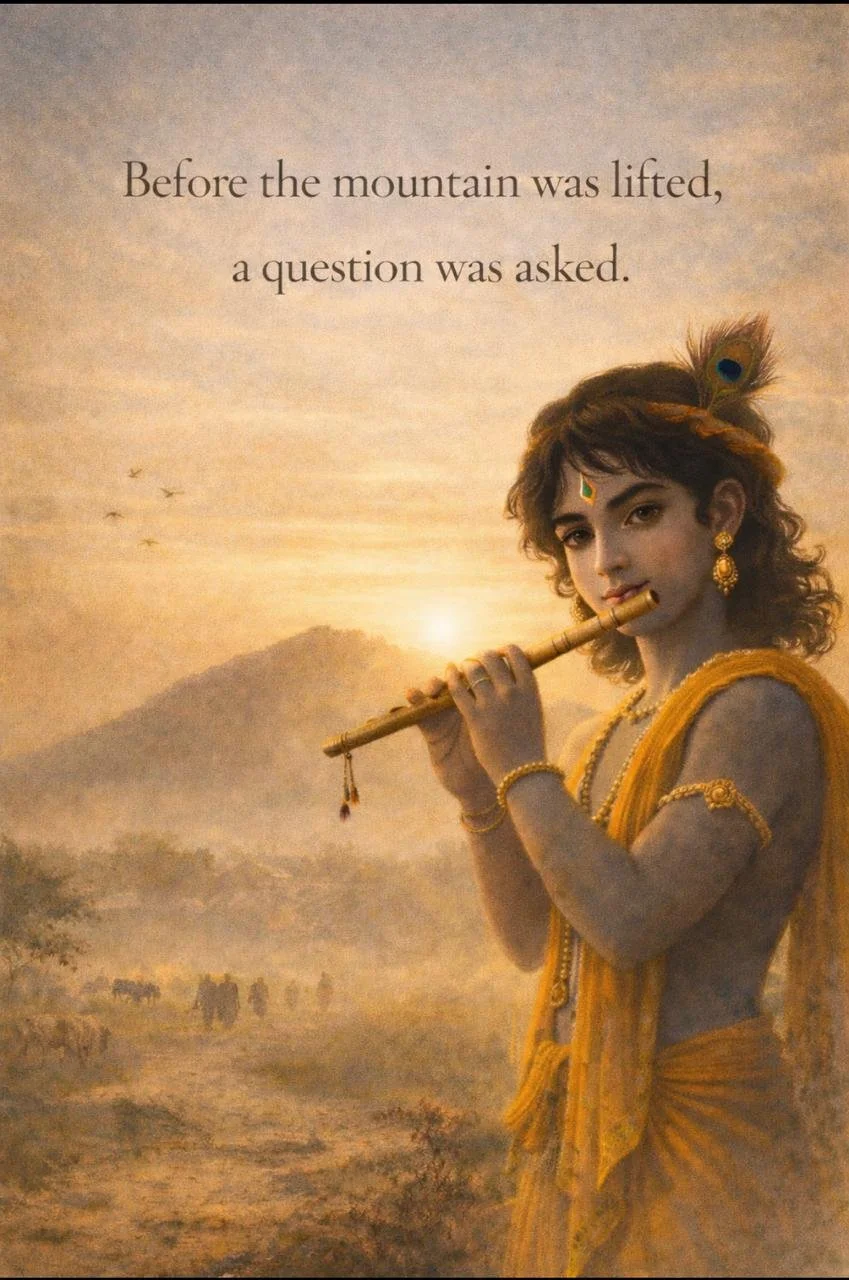
When Krishna Asked “Why?”
There are stories where Krishna lifts a mountain, plays a flute, or defeats a demon.
And then there are stories where He does something far more unsettling for the human mind.
He pauses.
He looks at what everyone accepts as “normal.”
And He asks one clean, innocent question:
“Why are we doing this?”
In Vrindavana, preparations were underway. The air carried the warmth of ritual fires. Grains were being measured, offerings arranged, voices moving in familiar rhythm. Everything looked correct from the outside. Everything felt “as it should.”
Yet Krishna did not rush into participation. He didn’t mock. He didn’t rebel.
He simply questioned the foundation.
That single “why” became a turning point.
Not loud. Not dramatic.
But deeply transformative.
Because rituals, like habits, can become empty if they lose grounding in purpose.
And sometimes, the most compassionate thing wisdom does is interrupt autopilot.
When tradition loses its purpose
Nanda Maharaja explained lovingly:
Indra brings rain. Rain gives harvest. Harvest sustains life. So Indra must be worshiped.
It is a logical chain.
And it mirrors a common human pattern. We often direct devotion toward what we believe controls our survival and success. Sometimes that shows up as fruit-seeking ritualism, a dependence on external forces for material outcomes.
The deeper point here is not about any deity or any community.
It is about human psychology.
When we are anxious, we start worshiping “results.”
We start pleasing “the sky.”
Approval. Authority. Systems. Outcomes. Recognition. Power.
Not because we love them, but because we fear what happens if we do not.
You can feel this in ordinary life too.
A person works harder and harder, not because the work is meaningful, but because the mind whispers: “If I slow down, I will lose my place.”
A relationship stays polite on the surface, not because there is peace, but because someone fears conflict will take away love.
A decision gets delayed again and again, not due to lack of intelligence, but due to fear of being blamed.
Krishna’s question quietly exposes this:
If devotion is driven by fear, it stops being devotion.
It becomes a negotiation.
And if a ritual is only tradition, without clear grounding in wisdom and purpose, it slowly loses its power to uplift.
A simple line to remember:
If it only preserves form, it may not transform the heart.
“Do not externalise the source of your well-being”
Krishna’s teaching is subtle and deeply practical.
He is reminding us to be careful not to outsource the source of our well-being entirely to external forces.
It is like depending on the clouds and forgetting the sun.
Mistaking the visible for the ultimate.
Yes, rain matters.
But there are deeper forces at play: law, balance, action, responsibility, time, nature, community, and the unseen intelligence that holds life together.
Krishna challenges superficial devotion that tries to flatter fate or blame fate.
He brings the mind back to a calmer truth:
Your outcomes are shaped by your actions.
Take responsibility for what you do.
Not with heaviness.
With dignity.
Because dignity returns the steering wheel to your hands.
Krishna’s radical simplicity: responsibility over fear
Krishna’s lens is simple:
Life responds to karma (our actions and choices).
Material phenomena unfold through the gunas (the modes of nature).
Cause and effect are real.
Worship must align with reality, context, and what truly sustains life.
This is a turning point:
From fear-based rituals to gratitude-driven living.
From pleasing what intimidates us to honouring what nourishes us.
From performative devotion to responsible, grounded spirituality.
A quiet but powerful shift happens when you live this way:
You stop asking, “How do I control everything?”
And you start asking, “How do I show up rightly?”
Govardhan as a symbol of what sustains you
For the people of Vrindavana, what truly sustained their life was not a distant force in the clouds.
It was their ecosystem:
the cows they protected
the land that fed them
the hill that sheltered, nourished, and supported their living
the community that carried wisdom, duty, and care
Govardhan, in this wisdom, is not inert.
It represents the sacred intelligence within nature and life itself, something conscious and responsive in how it supports and reflects us.
So Govardhan becomes a symbol of a mature kind of reverence:
Honour what generously sustains you.
In our own daily life, Govardhan may look like:
health that works quietly every day
family and support systems that hold us through unseen sacrifices
work done sincerely, even without applause
routines that keep us stable
values that keep us honest
communities that shape us
nature that nourishes us
And our personal “Indras” can be the things we chase with anxiety:
promotions, validation, image, control, power, constant reassurance.
Krishna’s message becomes extremely practical:
If something sustains your life, honour it.
If something demands fear, question it.
Another line to carry with you: “If it nourishes your life, it deserves your respect. If it steals your peace, it deserves your inquiry.”
When wisdom calls, evolve
This leela also carries a gentle invitation.
When wisdom calls, be open to evolving, even from long-held beliefs.
Like a river changing course to meet the ocean, tradition must blend into truth.
Not by rejecting the past.
By refining it.
Not by arguing.
By understanding purpose.
Because what we really seek is not ritual for its own sake.
We seek upliftment.
Clarity.
Stability.
A better quality of life.
True worship expands care
Another quiet message in this leela is about inclusion.
Krishna’s instruction is not narrow or exclusive. It is expansive:
Feed those who carry wisdom.
Feed the community.
Care for animals.
Do not forget those who are usually overlooked.
True devotion expands compassion.
If spirituality is excluded, it has become incomplete.
A simple test appears:
If spirituality makes the heart smaller, it has missed the point.
If spirituality makes the heart kinder, it is becoming real.
The most subtle moment: power with humility
At the end, Krishna accepts the offerings.
And then He bows, along with everyone else.
It’s a masterclass in conscious living:
Strength without ego.
Wisdom without dominance.
Leadership without pride.
A YourSukoon contemplation for today
Sit quietly for a moment and ask, just as Krishna did:
Why am I doing what I am doing?
Is it love, or fear?
Am I externalizing my well-being?
Have I started worshiping outcomes instead of honoring my ecosystem?
What truly sustains my personal and professional life?
Health, habits, relationships, duties, nature, community, values.
Is my spirituality making me more grounded, responsible, and grateful?
Or more anxious and performative?
And let this prayer arise simply:
May I honor my duties.
Respect what sustains me.
And live with awareness rather than fear.
This is the essence of the Govardhan journey, Part 1.
Not a debate.
Not a counter to any path.
A divine reminder for mankind:
to stay grounded, responsible, and spiritually authentic,
by shifting from fear-based rituals to gratitude-driven living.
And in the next part of this journey, we will step into the moment where grace becomes visible, and protection becomes unforgettable: the lifting of Govardhan.